

Hangzhou Banglin Bonding Technology Co., Ltd. was established in 2005 which is a national high-tech and specialized enterprise. Located in Hangzhou Future Science Industrial Park. Our company's self-invented and produced hot-melt adhesive products are widely used in various industries, including shoes and bags, automotive batteries, automotive interiors, food packaging, adhesive tapes, labels, tapes, medical supplies, household daily necessities, logistics and express delivery, etc.
Why Choose Us
High Quality
Our Hangzhou factory serves more than 3800 customers, covering 23 provinces and 343 cities. The products are exported to Southeast Asia, the Middle East, South America and other countires. We have a comprehensive management system for product research and development, quality control, safety production,employee service, and after-sales service .
Rich Experience
The company has successively introduced digital management software such as SAP workshop integration software MES, CRM, cloud barcode and Yida digital platform to assist the enterprise in building a strategic management system.
Professional Team
The company has established a technical team with professional application research and development capabilities. The R&D center covers an area of more than 500 square meters, importing the most advanced R&D testing instrument from the United States-- Rheometer. Meanwhile we also hire senior expertes with PhDs in the United States to provide coporate training and guidance.
Certificate
Our hot melt adhesive has successfully passed the ISO 9001 quality management system certification, which means that the production process and quality management have reached the internationally recognized high standards, and it is able to provide customers with stable and high-quality products. At the same time, it has also obtained the REACH and SGS certification. These certifications indicate that the chemical substances in the hot melt adhesive comply with the strict regulatory requirements of the European Union, effectively guaranteeing the health of users and environmental safety, and fully demonstrating our high emphasis on environmental protection and firm commitment to sustainable development.

IXPE/XPE Wall Stickers Hot Melt Adhesive
IXPE (Irradiated Cross-Linked Polyethylene) and XPE (Cross-Linked Polyethylene) wall stickers hot melt adhesive a versatile and practical choice for enhancing the look and functionality of various spaces.

PMMA Wall Stickers Hot Melt Adhesive
PMMA wall stickers can be produced in a variety of finishes, including matte, glossy, and frosted, enhancing the aesthetic appeal of the stickers for different decorative purposes.

PET Wall Stickers Hot Melt Adhesive
Hot melt adhesives a popular choice for PET (Polyethylene Terephthalate) wall stickers, ensuring they adhere well, are easy to apply, and maintain their appearance over time.

Pressure sensitive hot melt adhesive commonly used in peel-and-stick wallpapers, decals, and tapes, pressure-sensitive adhesives adhere instantly when pressed to a surface. They are easy to apply and remove without leaving a residue, making them ideal for home decorations.

3D Wall Paper Hot Melt Adhesive
Hot melt adhesive in 3D wallpaper combines durability, ease of use and flexibility, making it a reliable choice for fixing heavier materials with minimal effort.

Hot melt glue is a versatile and effective adhesive solution for wall stickers, balancing strong adhesion with the convenience of easy application and clean removal.
Hot melt glue is a versatile and effective adhesive solution for wall stickers, balancing strong adhesion with the convenience of easy application and clean removal.
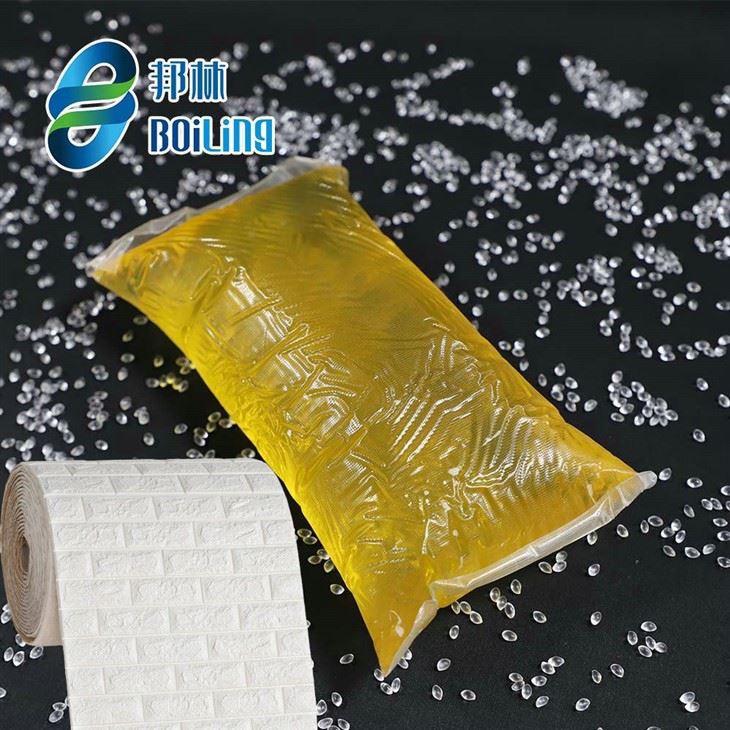
XPE Wall Stickers Hot Melt Adhesive
The hot melt adhesive in XPE wall stickers provides an efficient, strong, and sometimes repositionable bonding solution, making it a popular choice for easy DIY wall decoration.
PMMA Wall Stickers Hot Melt Adhesive
PMMA wall stickers can be produced in a variety of finishes, including matte, glossy, and frosted, enhancing the aesthetic appeal of the stickers for different decorative purposes.
PET Wall Stickers Hot Melt Adhesive (also known as hot glues) are generally 100% solid formulations based on thermoplastic polymers (no water or solvents are involved). Hot melts are sold in a solid state at room temperature and are 'activated' upon heating beyond their softening point which is usually between 50 and 160 degrees. Once melted (in a hot melt tank), the adhesive can then be applied onto a substrate in its liquified or molten state. The hot melt wets the substrate, penetrating the surface (and any cavities), and then it solidifies, ensuring cohesion. This setting/cooling process takes very little time. Glues that cool and remain tacky are known as pressure sensitive adhesives (PSA)
Benefits of PET Wall Stickers Hot Melt Adhesive
Dispensing is easily automated
Unlike other adhesives, manufacturers tend to find that hot melts are not only very efficient at bonding but dependable and consistent products. Hot melts do not taint substrates and can be used across a wide range of both slow and fast machines, during all seasons. Their dispensing is easy to automate and hot melts offer a very consistent application with a better glue line and coat weight than other adhesives.
clean and easy to handle
Hot glues are considered a cost-effective choice due to factors such as better mileage, lower maintenance costs, lower downtime and lower inventory costs. They have a long shelf life and before being used are 100% solid, so are clean and easy to handle and easy to store.


Ease of use and clean running characteristics
Hot melts are known worldwide for their bond effectiveness, ease of use and clean-running properties (no stringing for example), but they also offer excellent thermal stability, so stay clear in the glue tank and do not char. This distinctive characteristic eliminates the pesky nozzle blockages associated with less advanced adhesives which can continually disrupt on-site production and add cost to the whole process.
Non-hazardous and environmentally friendly
Hot melts do not contain solvents, so one of their main advantages is that they are considered non-hazardous and eco-friendly. PET Wall Stickers Hot Melt Adhesive have no fumes, little smell, low toxicity levels, contain little to no VOCs (volatile organic compounds) and there is minimal waste produced in their manufacturing process. When disposing of a hot melt, there are few or no environmental precautions to consider.
How a hot melt differs PET Wall Stickers Hot Melt Adhesive
PET Wall Stickers Hot Melt Adhesive have surpassed the efficiencies of their predecessors in many ways, which is one of the reasons why they have become so popular today.
In addition to ease of use, and lower processing costs and regulatory requirements, one of the main reasons why a hot melt is the adhesive of choice in many markets is due to its unrivalled versatility.
PET Wall Stickers Hot Melt Adhesive can be used to bond a great range of substrates from cardboard, metal, glass, leather and wood to ceramics, plastic, rubber, fabric and foam. The high viscosity of a hot melt makes it suitable for use on both non-porous and porous substrates which would otherwise be more difficult to bond with, say, a solvent-based adhesive.
Thanks to factors such as their excellent water and moisture resistance (they don't weaken when exposed to humidity), PET Wall Stickers Hot Melt Adhesive create tamper-resistant seals. Hot melts can therefore be used on hot, cold and wet surfaces and, because they're thermoplastic, they can be repeatedly heated to melt and cooled to solidify. There's no one-time usage with a hot melt, which is often the case with other adhesives.
Unlike solvent-based glues, hot melts do not lose their thickness when they solidify. Being 100% solid formulations, hot melts shrink minimally when being cooled which is why they are excellent at filling gaps.
Hot melts are favoured by many customers because they can cool down and dry almost instantly (unlike water-based and solvent-based adhesives), providing an ultra-fast method of bonding. This gives manufacturers the option of speeding up their production lines, making the entire process more efficient – perhaps one of the biggest hot melt selling points and why they are commonly used in FMCG (fast moving consumer goods) packaging applications.
Type of PET Wall Stickers Hot Melt Adhesive
Acrylic Adhesives
Acrylic adhesives are resin-based adhesives composed of methacrylic or acrylic polymers. An acrylic adhesive is extremely strong and efficient in making multiple bonds. It's preferred in the construction industry due to its resistance to environmental elements like excessive sun and rainfall.In terms of strength and ability to hold items, not too many adhesives compare to acrylic adhesives.
Epoxy Resin Adhesives
Epoxy resin adhesives are well-known for their dimensional stability, high mechanical strength,chemical resistance, and affordability. The strength of epoxy adhesives makes it a great option when bonding steels, non-ferrous metals, aluminum, fiber-reinforced composites, ceramics, bricks,foamed structures, glasses, and woods.
Epoxy adhesive systems consist of a base resin, an accelerator, a hardener, fillers, flexibilizers,additives, and diluents. The base resin used in the production of epoxy resin adhesives determines its chemical resistance and thermal stability.
Anaerobic Adhesives
Anaerobic adhesives are composed of dimethacrylate monomers and cures only when oxygen is absent. Compared to other types of adhesives, anaerobic adhesives are less toxic, mild, and non-
corrosive to metals, features that make them ideal for usage in construction.
Besides dimethacrylate monomers, anaerobic adhesives also comprise multi-functional and monofunctional ester monomers, stabilizers, a redox radical initiator system, different types of
modifiers, and resins.
Pressure Adhesives
Pressure adhesives rely heavily on viscosity and elasticity to bond to a surface. As suggested by the name, pressure adhesives work when pressure is applied between the adhesive and the point of attachment.
This type of adhesive is commonly used on stickers and can't be relied on to hold two substances together. In construction, it can come in handy in sticking cautionary notices such as danger signs or on-site instructions.
Electrically Conductive Adhesives
Electrically conductive adhesives are commonly used in electronic applications,more so where electrical current needs to pass between two or more items. This type of adhesive cures in under two minutes and is mostly made from 80% conductive particles.
The base adhesive is usually a 2-component epoxy, although polyester and acrylate are also common options. Conductive components used in electric conductive adhesives usually determine the overall cost.
Plastisol Adhesives
Plastisol adhesives consist of polyvinyl chloride(PVC) particles that are dispersed in a plasticizer.
They have great peel resistance and high flexibility, features that make them ideal for usage in construction. However, the main problem with plastisol adhesives is their sensitivity to shear stress.Plastisol adhesives are also susceptible to creeping when subjected to extra heavy loads.
PET Wall Stickers Hot Melt Adhesive are manufactured in several formulations, each constructed specifically to provide the unique viscosity, melting point, and adhesion strengths necessary to make it ideal for a certain application. Depending on the strength of the bond needed, the ideal set time, the preferred viscosity, and the type of substrate that will be used, manufacturers can alter certain adhesive properties to fit it for almost any use.
Type of polymer
The type of polymer used primarily affects the adhesive melting point and can impact the final bond's strength. In addition, different polymers can add flexibility, increase or reduce adhesion, and add chemical resistance. Finally, the polymer chosen can also affect the final application process.
Adhesive temperature
The temperature of the hot-melt adhesive used affects the bond strength and appearance of the final product. Within the ideal temperature range, the adhesive becomes liquid and can adequately seep into the substrate's pores. Outside the ideal range, the adhesive can remain too stiff to bond with the substrate, have improper surface tension, fail to wet the surface, or char in the pot and become less effective.
Environmental temperature
While adhesive temperature is of primary concern while in the application machinery, ambient temperature can affect bonding. If the substrate or surrounding air temperature is too cool, adhesive can set too quickly, preventing bonding.
Amount of adhesive product
A larger surface area of the adhesive product allows more of the hot-melt adhesive to seep into the substrate's pores and provide a strong bond. The amount of product necessary can depend on the adhesive strength, the substrate used, and the nature of the particular application.
Porosity of the substrate
The surface characteristics of the substrate used can impact bond strength. Absorbent or rough materials may consume too much adhesive, while glossy or non-porous materials may not allow the proper bonding between substrates and adhesive.
Evaluating adhesive requirements
Market trends - such as sustainability - influence our development programme, with adhesives that are bio-based, vegan-friendly, or glues that are suitable for pallet stabilisation (that help reduce overall plastic usage), being good examples of products that are driven by customer demands.
Formulating new adhesives
Using the latest formulation technologies and raw materials, we design adhesives that fulfil the necessary performance requirements and likely application methods, as well as compliance with the latest and relevant accreditations – whether this is for food contact approvals or flame retardeness, amongst many others.
PET Wall Stickers Hot Melt Adhesive developments are also rigorously tested and critically analysed using both standard industry and inhouse methods to accurately check and record the adhesive's properties: typically, this includes, but is not limited to, the glues viscosity, open time, setting speed, adhesion characteristics, and hot and cold temperature performance.
Launching new adhesive grades
Naming products, assigning internal codes, barcoding, highlighting the adhesive's key features and benefits, and creating marketing collateral, are all part of the process of promoting the new adhesive to our distribution partners and the wider market.

Hangzhou Banglin Bonding Technology Co., Ltd. was established in 2005 which is a national high-tech and specialized enterprise. Located in Hangzhou Future Science Industrial Park. Our company's self-invented and produced hot-melt adhesive products are widely used in various industries, including shoes and bags, automotive batteries, automotive interiors, food packaging, adhesive tapes, labels, tapes, medical supplies, household daily necessities, logistics and express delivery, etc.
Certificate

FAQ


