

Hot melt adhesives are widely used in various industries due to their fast bonding speed, strong adhesion, and environmental - friendliness. As a hot melt adhesives supplier, we often receive inquiries from customers regarding the factors that affect the performance of hot melt adhesives. One such crucial factor is the adhesive thickness. In this blog post, we'll delve into how the adhesive thickness of hot melt adhesives impacts its performance.
I. Impact on Adhesion Strength
Adhesion strength is one of the most important performance indicators of hot melt adhesives. The relationship between adhesive thickness and adhesion strength is complex and non - linear.
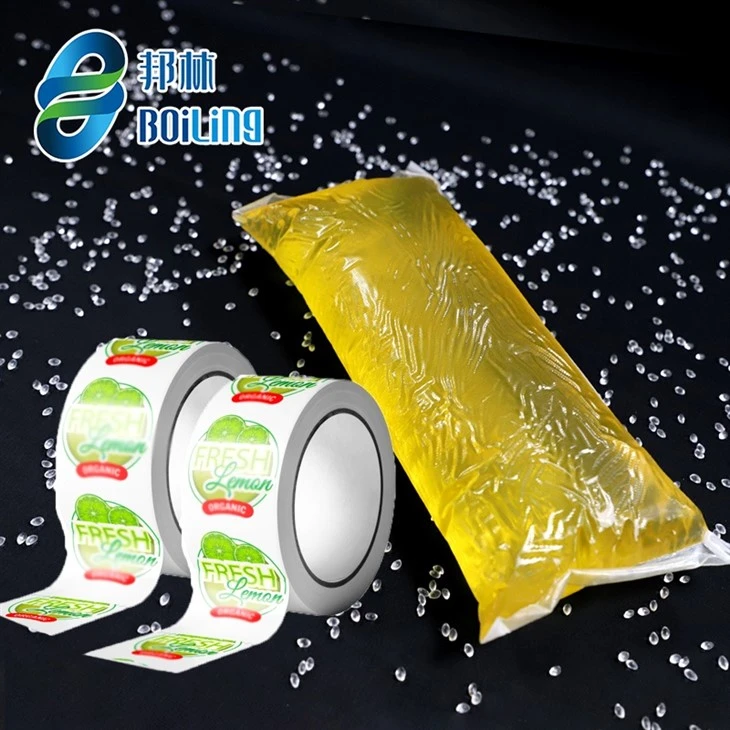
When the adhesive thickness is too thin, there may not be enough adhesive material to form a sufficient number of molecular bonds with the substrate. The limited amount of adhesive restricts the contact area between the adhesive and the substrate at the molecular level. For example, in the labeling industry, if we use a Hot Melt PSA Glue With Good Die - Cutting Feature For Label with an extremely thin application, the glue may not be able to fully adhere to the label and the product surface. This can lead to labels peeling off easily, which is unacceptable in a commercial setting.
On the other hand, an overly thick layer of hot melt adhesive does not necessarily mean stronger adhesion. In fact, when the adhesive layer is too thick, it may lead to the formation of air bubbles within the adhesive. These air bubbles act as weak points in the adhesive layer, reducing the overall integrity of the bond. Additionally, a thick adhesive layer may take longer to cool and solidify. During this extended cooling period, the adhesive may be more prone to deformation, which can also affect the adhesion strength. For instance, when using Sealing Label Hot Melt Adhesive, an excessive thickness can cause the seal to become less reliable over time as the adhesive may shift or flow.
Research has shown that there is an optimal adhesive thickness range for maximizing adhesion strength. This range varies depending on the type of hot melt adhesive, the nature of the substrates being bonded, and the application conditions. For most general - purpose hot melt adhesives used in packaging, the optimal thickness usually falls between 0.1mm and 0.3mm.

II. Impact on Drying and Cooling Time
The drying and cooling time of hot melt adhesives is another significant performance aspect that is affected by adhesive thickness. Hot melt adhesives work by melting at a high temperature and then solidifying upon cooling to form a bond.
A thinner layer of hot melt adhesive cools and solidifies much faster than a thicker one. This is because the heat transfer is more efficient in a thin layer. In high - speed production lines, such as in the manufacture of disposable products, a fast - drying adhesive is crucial. With a thin layer of hot melt adhesive, the production process can run smoothly without long waiting times for the adhesive to set. For example, using a thin layer of Pressure Sensitive Hot Melt Adhesive For Film Labels on film labels allows for quick lamination and further processing of the products.
Conversely, a thick layer of hot melt adhesive retains heat for a longer period. This slow cooling process can be a disadvantage in production as it may slow down the entire manufacturing process. Moreover, during the extended cooling phase, the adhesive may be exposed to more external factors such as vibrations or slight movements, which can disrupt the bonding process and lead to a weaker bond.
III. Impact on Flexibility and Durability
Flexibility and durability are important characteristics, especially for applications where the bonded parts are subjected to movement or stress.
When the adhesive thickness is in the appropriate range, the hot melt adhesive can provide good flexibility. A well - applied thin - to - medium - thickness layer of adhesive can conform to the movement of the substrates without cracking or losing its bond. For example, in the automotive industry, where parts may experience vibrations and thermal expansion and contraction, a properly thick layer of hot melt adhesive can maintain its integrity and flexibility.
However, if the adhesive is too thick, it is more likely to become brittle and lose its flexibility over time. The thick mass of the adhesive may not be able to accommodate the movement of the substrates, leading to cracking or delamination. This reduces the durability of the bond and may require more frequent repairs or replacements.
IV. Impact on Cost - effectiveness
Adhesive thickness also has a direct impact on the cost - effectiveness of using hot melt adhesives.
A thicker layer of adhesive means using more raw material. This increases the material cost per unit of the bonded product. For businesses that rely on large - scale production, such as the packaging industry, the increased cost of adhesive can add up significantly over time.
On the other hand, a very thin layer of adhesive, although it reduces the material cost, may lead to inferior bond quality. This can result in higher rejection rates during quality control, which also adds to the overall cost. Therefore, finding the optimal adhesive thickness is essential for achieving the best cost - effectiveness.
Conclusion
In conclusion, the adhesive thickness of hot melt adhesives plays a vital role in determining its performance in terms of adhesion strength, drying and cooling time, flexibility and durability, and cost - effectiveness. As a hot melt adhesives supplier, we understand the importance of proper adhesive thickness. We strive to provide our customers with high - quality hot melt adhesives and professional advice on the optimal adhesive application thickness for different applications.
If you're interested in learning more about our hot melt adhesives or need assistance in choosing the right product for your specific requirements, please don't hesitate to contact us for purchase negotiation. We look forward to working with you to achieve the best bonding results.
References
- Satas, D. (Ed.). (1999). Handbook of Pressure - Sensitive Adhesive Technology. Van Nostrand Reinhold.
- Skeist, I. (Ed.). (2017). Handbook of Adhesives. CRC Press.
- Mittal, K. L. (Ed.). (2016). Fundamentals of Adhesion. CRC Press.